 Most Read
Mostly a Multivitamin, With a 609-Milligram Blend of Eighteen Things Stacked on Top and No Amount Printed for Any of Them: What Two Capsules a Day From a Texas Seller Count, What They Don't, and the Lead Notice at the Bottom of the Listing
Neuro Plus is a thirty-nine-dollar bottle of sixty capsules from WOWMD, an online seller in Missouri City, Texas: twenty-two vitamins and minerals with an amount beside each, then a proprietary blend of eighteen plant extracts and nutrients that shares 609 milligrams among them without saying how. I read the twenty-two lines the way you'd read a multivitamin's, read the blend against the trials of its four best-known members, read the two different directions the label and the listing give, and read the California lead notice at the bottom of the listing that most buyers scroll past.

This is a paid advertisement. Sponsored by WOW MD LLC.

Vernon Ashcroft is the pen name of this desk.
The customers quoted on this page are real; their reviews are public on the seller's product page and were read there on September 9, 2026.
I haven't met them and know nothing about them beyond what they wrote.
The small photos beside their reviews are illustrations, not the reviewers.
Everything about the bottle, from the twenty-two counted lines to the lead notice, comes from the seller's own label and pages, read the same day.
Every bottle of this kind has a front half and a back half, and this one wears the split on its label.
The front half is a multivitamin, twenty-two lines long, every one with a number.
The back half is a blend: eighteen names sharing 609 milligrams, and not one of them with a number of its own.
A man can check the front half against the government's own Daily Values in ten minutes, and can't check the back half against anything, because there's nothing to check.
A multivitamin in front, a blind blend behind.
That's the bottle, and it's what this page is: the twenty-two lines counted, the eighteen names read against the trials of the four you've heard of, and two things on the listing the reviews don't mention.
One is a pair of directions that don't agree, and the other is a notice about lead.
Two capsules a day, with food by the label, twenty to thirty minutes before a meal by the listing. Every number on this page is for those two capsules.
Here's what the bottle is.
Neuro Plus Brain and Focus Formula, from WOW MD LLC, an online seller in Missouri City, Texas, with a toll-free number, an email and a street address on its contact page, and a returns warehouse in Utah.
A white bottle of sixty vegetable capsules, which at two a day is thirty days, with a blue "Neuro Plus" on the front, a figure drawn inside a brain, and the words "600mg+ per serving," which count only the blend.
The panel is long, and I'll give it to you in two halves, the way it's printed.
The listing describes the capsules with a word borrowed from the world of study aids that our advertising rules don't allow, and I won't use it.
It also promises, in its description and in several of its reviews, two things about how a man feels day to day, and this page makes no claim about either.
I did what I always do.
I read the label before the listing.
I read the twenty-two counted lines against the Daily Values and against the large trials of vitamins in older people.
I read the eighteen names in the blend against the trials of the four that have real trials, at the doses those trials used, and did the arithmetic on what 609 milligrams shared eighteen ways can hold.
I read the ten most recent reviews and the fifteen after them, all from this summer.
And I read the lead notice at the bottom of the listing, the two directions, the shipping page, which charges for a single bottle, and the refund page, which covers one.
What I found is a multivitamin with a few lines high enough to ask about, a blend that can't hold the trial dose of its best-known member even if it held nothing else, a listing that promises more than the panel can carry and says so in a word I can't print, and a lead notice that belongs above the reviews rather than below them.
One more thing before the first beacon, because most of you got here from one of our own advertisements.
Those ads talk about a boxed cereal, three foods, three drinks, and three words or phrases a man is supposed to be able to say.
None of that is in the capsule, and I won't pretend it is.
It's on this page, in its place: the cereal, the drinks and the word test are the seventh beacon, and the honest version of every headline we run is in the guide linked at the foot.
Beacon one · The bottleA White Bottle, Sixty Capsules, and a Panel Printed in Two Halves
This is what's on the counter.
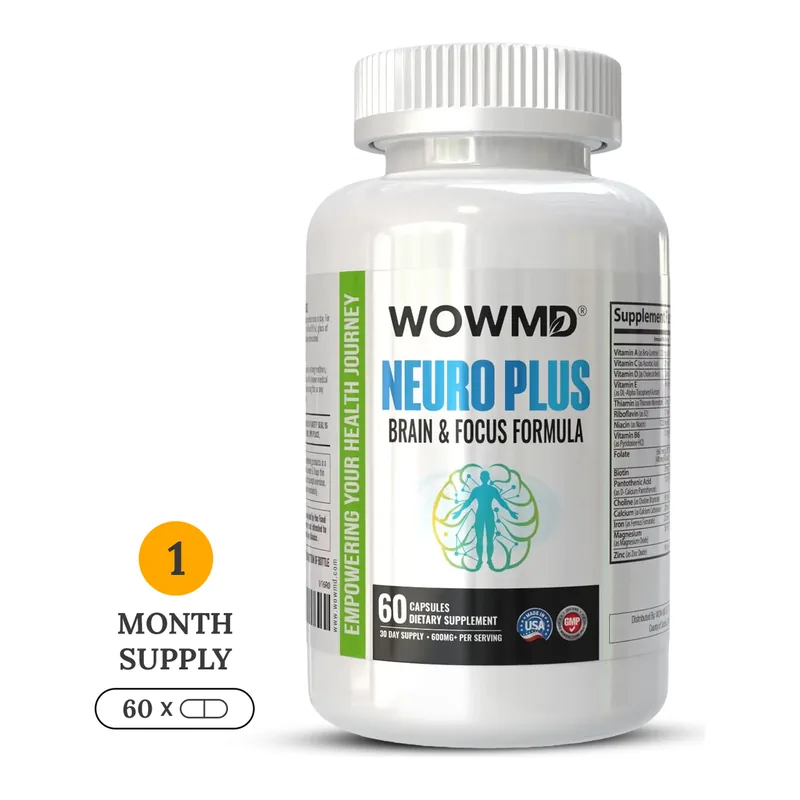
A white plastic bottle with a silver cap, a blue product name, a green band down the side, and two seals on the front, one for good manufacturing practice and one that says made in the USA.
The back is the panel, and I'll read it to you in the seller's order, per two capsules.
The first half: vitamin A as beta-carotene, 122 micrograms; vitamin C, 125 milligrams; vitamin D, 3 micrograms; vitamin E, 40 milligrams; thiamin, 3 milligrams; riboflavin, 1.7; niacin, 12.5; vitamin B6, 12 milligrams; folate, 680 micrograms; biotin, 3 micrograms; pantothenic acid, 12 milligrams; choline, 50 milligrams.
Then the minerals: calcium 20 milligrams, iron 2.6, magnesium 50, zinc 10, selenium 50 micrograms, copper a twentieth of a milligram, manganese 0.4, chromium 12 micrograms, molybdenum 10 micrograms, potassium 94 milligrams.
The second half, in the seller's order and with no amounts: a proprietary blend of 609 milligrams holding DMAE bitartrate, L-glutamine, glutamic acid, green tea leaf extract, bacopa extract, inositol, bilberry fruit extract, GABA, grape seed extract, grapefruit seed extract, olive leaf, cassia bark extract, licorice root extract, boron, DHA at "14 percent," vanadium, phosphatidylserine from soy, and huperzine A from whole herb.
Other ingredients: rice flour, the capsule, magnesium stearate, silicon dioxide.
Contains soy and fish, the label says, and names the fish: tuna.
The directions on the label's own photograph: take two capsules daily with food.
Twenty-two numbers on the front half and none on the back, on the same panel.
The front half is a multivitamin, and it gets the next beacon; the back half is the reason for the price, and it gets the two after that.
Beacon two · The front halfTwenty-Two Lines With Numbers, Six of Them Above a Day's Worth, and One I'd Ask About
The half of the panel you can check, and the half that's cheapest to buy anywhere else.
Read it as a multivitamin, because that's what it is.
Six lines are above a full day's worth by the label's own percentages: vitamin B6 at 706 percent, vitamin E at 266, thiamin at 250, pantothenic acid at 240, folate at 170, and vitamin C at 139. [1]
Two more, zinc and selenium, sit at 91 percent, and the rest are small: vitamin D at 15 percent, vitamin A at 14, choline at 9, calcium and potassium at 2.
None of those high numbers is near a limit that matters, and every one of them is the kind of figure a drugstore multivitamin prints.
What do vitamins at these amounts do for the thinking of a healthy older man?
The best answer is a big one: a 2018 Cochrane review pooled fourteen trials of B-vitamin supplements, folic acid, B12, B6 and combinations, in 27,882 adults without memory trouble, and concluded they probably have little or no effect on overall thinking scores at any point up to five years. [2]
Vitamin E has its own large trial: 6,377 healthy women aged sixty-five and older took 600 international units on alternate days for years, and it made no difference to their thinking. [3]
That dose was about fifteen times this line, and the trial found nothing.
The front half is a multivitamin at multivitamin amounts, and the big trials of those amounts in people my age come out even.
Nobody should pay a brain-formula price for it, and nobody should worry about it either, with one exception.
The exception is iron: 2.6 milligrams, 14 percent of a day.
A small amount, but iron is the one line on a multivitamin that men over fifty are often told to skip, because most of us get what we need from food and the body holds on to the rest, and it's the line I'd read out to the pharmacist first.
Twenty-two counted lines at multivitamin amounts: six above a day's worth, none near a limit, and iron the one to ask about. The honest half of the panel, and the cheap one.
Beacon three · The blendSix Hundred and Nine Milligrams Shared Eighteen Ways, Against Trials That Used Three Hundred of One Thing
The half of the panel the price is for, and the half you can't check.
A proprietary blend is a legal way to print names without amounts: the law requires the total and the order, heaviest first, and nothing else.
So what we know is that DMAE bitartrate is the largest of the eighteen and huperzine A the smallest, and that all eighteen together weigh 609 milligrams.
Six hundred and nine milligrams, eighteen names, no arithmetic.
Now the arithmetic the label won't do.
Shared evenly, 609 milligrams among eighteen is about 34 milligrams each; shared unevenly, which is how blends are built, the first few names could hold most of it and the last ten could be a pinch apiece.
Take the four names on the list with real trials in people, and set them beside the total.
Bacopa first, because it's the herb men my age ask about: in two twelve-week trials, fifty-four healthy adults over sixty-five and ninety-eight over fifty-five took 300 milligrams a day of a standardized bacopa extract on its own, and the bacopa groups did better on delayed word recall and verbal learning. [4] [5]
A 2014 analysis pooled nine such trials, 518 people, all at least twelve weeks, and found faster performance on two measures of attention. [6]
Three hundred milligrams, standardized, alone, for twelve weeks: that's half of this whole blend, and bacopa is the fifth name of eighteen.
Phosphatidylserine, the seventeenth name: its six-month trial in seventy-eight Japanese adults aged fifty to sixty-nine used 100 or 300 milligrams a day on its own, and scores rose in all groups, the placebo included. [7]
Whatever share of the 609 it holds, it's the second-to-last name on the list, which under the law means near the smallest.
GABA, the eighth name: one experiment in healthy young adults used a single 800-milligram dose and found fewer errors on one attention task, and its authors called the result preliminary and said it's still unresolved whether GABA taken by mouth reaches the brain at all. [8]
Eight hundred milligrams is more than this whole blend.
And huperzine A, the last name, which is the one that worries me the other way.
It's a compound from a club moss that's measured in millionths of a gram: in one study, single doses of 100 or 200 micrograms changed an enzyme in the blood, the higher dose held recall steady across sessions, and neither improved overall performance. [9]
A compound that acts at a fifth of a milligram, on a panel that won't say how much of it is in the capsule, is not a line a careful man takes on faith.
It's the line I'd ask the seller for a certificate on, in writing, before the first bottle.
The other fourteen names are a mixed bag: an amino acid the body makes by the gram, a sugar-like compound the kidneys make by the gram, six plant extracts with no memory trial at any dose, two trace minerals, a "14 percent" DHA that doesn't say 14 percent of what, when the fish-oil trials that found anything used more than a gram a day, [10] and green tea extract, which brings caffeine the label doesn't declare. [11]
And DMAE, the first and largest name, which the same federal notice that concerns another page on this desk lists alongside developmental studies announced in 2019. [12]
A blend of eighteen that can't hold the 300 milligrams of the bacopa trials even if it held nothing else, with a potent last name measured in micrograms and no number beside it. The half of the panel the price is for, and the half nobody can check.
Beacon four · The noticeThe Lead Notice at the Bottom of the Listing, and What It Does and Doesn't Mean
The line on the listing that the reviews never mention, and the one I'd read before them.
Near the bottom of the seller's page, under the cart and the payment logos, is a notice printed for California residents: this product can expose you to chemicals including lead, which is on the state's list of substances linked to serious harm.
That's the state's required notice, in plainer words than it prints, and the seller prints it.
Here's what it does and doesn't mean.
California's law requires that notice on any product that could expose a person to more than a very small daily amount of a listed chemical, and plant extracts of every kind, bacopa and green tea and licorice among them, carry traces of lead from the soil they grew in.
So the notice tells you the seller knows the capsules can exceed California's threshold; it doesn't tell you by how much, and neither the label nor the listing prints a figure.
A seller that prints the notice and also says its capsules are tested for heavy metals, as this listing does, is a seller you can ask for the number.
Read the lead notice before the reviews.
I'm not going to tell you the amount is dangerous, because I don't know it, and I'm not going to tell you it's nothing, because the seller didn't say so either.
I'm going to tell you to email the address on this page, ask for the certificate of analysis for the lot you're sent, and read the lead line on it before you open the bottle.
A California lead notice, printed by the seller, without a figure. Not a reason to panic, and not a line to scroll past: it's the one thing on this listing you can ask for in writing.
Beacon five · The two directions"With Food" on the Label, "Twenty to Thirty Minutes Before a Meal" on the Listing
A small thing, and the kind of small thing that tells you who wrote which page.
The label's own photograph says: as a dietary supplement, take two capsules daily with food or as directed by your healthcare professional.
The listing's "suggested use" says: take two capsules once a day, and for best results take them twenty to thirty minutes before a meal with an eight-ounce glass of water.
With food and before food aren't the same instruction, and a man who follows the bottle will do one thing while a man who follows the website does the other.
Neither will come to harm, but a seller whose label and listing disagree on the only instruction it gives is a seller whose other pages you read twice.
I'd follow the label, because it's the document that went through printing and the one that will be in your hand.
And I'd notice, as I did, that the listing's version comes with the promise of "best results," which is a phrase, not a study.
Two directions for one bottle. Follow the label, and let the "best results" line go.
Beacon six · The reviewsFive Hundred and Forty Reviews, All Twenty-Five I Read From This Summer, and the Five I Kept
The seller's page counts 540 reviews with an average of 4.7 stars, through a review system that marks confirmed buyers, and it showed me twenty-five: twenty-two five-star, three four-star, every one of them dated between May and August of this year.
That last fact is worth a sentence: a product with 540 reviews whose first twenty-five all fall in four months is either selling very fast or showing you a chosen page, and I can't tell you which.
The names are first names with an initial, the way the system prints them, and most of the reviews read alike: focused at work, less scattered, sharper by afternoon.
I kept five, all with the buyer's mark and none marked as rewarded, and I chose the five that say something a man can picture.
I threw out two that promise things about how a man feels day to day, which this page doesn't discuss; two that use a phrase for a cloudy head that our rules don't allow; one from a student's exam season; one that compares the capsules to coffee; and fifteen that repeat the five below in different words.
These are real customers, quoted word for word from the seller's product page; the small photos beside them are illustrations, not the reviewers.

My wife says I’m less forgetful. That’s a win.

I can read a book for an hour without my mind wandering.

Good quality ingredients. The Bacopa Monnieri is a nice touch.

I feel more articulate and quick on my feet in conversations.

Since starting this, I feel more focused when reading, planning, and handling work, and my mind does not wander off nearly as much as it used to.
Read those the way I did.
Thomas reports his wife's verdict, which is the most reliable instrument in most households and still not a trial.
Linda describes an hour with a book, which is the thing men my age most want back and the thing a notebook can actually measure.
Robert gives four stars and praises the bacopa, and he's right that it's a nice touch; he doesn't know how much of it he's getting, and neither do I.
Michael describes conversation, and Joseph describes work.
Both are describing a summer, not a study.
Nobody I kept describes a trial result, because no trial of these capsules exists, and nobody mentions the lead notice, because it's below the reviews.
Five people who bought it, twenty who sound like them, and a count of 540 I couldn't page through: that's the honest shape of the reviews.
Beacon seven · The bowl and the cupThe Cereal, the Three Drinks, the Three Foods and the Word Test From Our Own Advertisements
Our advertisements have been saying, in one version or another, that a boxed cereal, three foods and three drinks have something to do with memory, and that there are three words or phrases a man ought to be able to say.
You're owed the honest version, on one beacon, so here it is.

Start with the bowl.
A frosted, honey-coated or chocolate cereal is mostly refined starch and added sugar, and a serving can carry more sugar than a cookie.
No cereal "ages the brain faster than time."
Nobody has measured any such thing, and that phrase was written to be clicked.
What the studies do say is duller, and worth more.
In the Framingham Heart Study, adults who drank more sugary beverages scored lower on tests of memory, and daily fruit juice went the same way. [13]
In a Brazilian study of 10,775 adults followed for eight years, the ones who ate the most ultra-processed food, and the sweet cereal shelf is part of that, lost ground on tests of thinking about a quarter faster than the ones who ate the least. [14]
Both are associations across a population, not a sentence on your bowl.
And a quarter faster than slow is still slow.
The same Framingham families, in a different analysis, scored better on memory tests when their diets carried more choline, [15] which is eggs, milk, meat and beans, and a better argument for breakfast than for the 50 milligrams on this panel.
The three drinks.
The "evening drink" in our advertisement is alcohol, and it's the one with the strongest case behind it: in 550 British civil servants followed for thirty years, the more a person drank, the faster their scores fell on a word-fluency test, and light drinkers had no edge over those who didn't drink at all. [16]
The second is sugar in a glass: soda, sweetened tea, the tall flavored coffee from the counter, which is a soft drink with coffee in it.
The Framingham finding above is about sugary drinks, and those are sugary drinks. [13]
The third, in one of our headlines, was coffee.
That was our worst headline.
Plain black coffee and plain tea aren't the drinks any of those studies were about.
Keep your coffee.
One honest note about the cup: these capsules hold a green tea extract, and green tea carries caffeine, so the capsules bring an undeclared little of it to your morning.
The label doesn't say how much, and the sensible assumption is a small amount.
The three foods.
Processed meat, fried food, and the white-flour shelf: pastries, packaged cakes, white bread.
Our advertisement says "just stop eating these three."
The research says something slower.
In 960 older adults followed for nearly five years, the ones whose meals looked most like the MIND pattern, vegetables, berries, nuts, whole grains, beans, fish and olive oil, held their thinking scores better, and the gap between the top and bottom thirds worked out to about seven and a half years of age. [17]
That's a pattern over years, not a list of three, and it can't be sold in a headline.
Which is exactly why our headline doesn't say it.
Less sugar in the bowl and the glass.
Less alcohol in the evening.
Keep the coffee.
Eat more like the Mediterranean shelf and less like the vending machine.
Every one of those costs nothing, and none of them is in the capsule.
The three words, or the three phrases.
There's no such list.
What our advertisement borrowed from is the short, scored mental-status test clinicians have given at the bedside since the 1970s: the date and the place, a few words to hold in mind and give back a minute later, a sum, naming, repeating one sentence, copying a drawing.
It's given in person and read against your age and your schooling by someone trained to do it, and a low score is a reason for a proper look, not a verdict.
Stumbling on a word when you're tired or being timed means nothing on its own.
Nothing begins at a word.
If the worry behind the click is real, that's fifteen minutes with your own clinician, and it costs you nothing from me.
And the advertisement about the things some men take every day.
That one sits closest to real research, and it's the one an advertisement has no business acting on.
Some kinds of daily medicine, including a few sold over the counter for allergies and for the night, are on the lists pharmacists check for people over 65.
Don't stop or change any of it because of an advertisement, ours included. Put everything you take in one bag, this bottle included, take it to the pharmacist, and ask one question: is anything here a poor choice at my age?
Huperzine A and the iron line are the two things on this panel worth naming at that counter, and a green tea extract is worth naming if you've ever been told to watch your liver. [11]
The guide at the foot of this page has that section written out, with the studies.
So if you clicked on the cereal, here's where the cereal went: onto the counter next to a bottle that has nothing to do with it, where the real answer was always a plainer bowl and a walk along the water.
Beacon eight · What it isn'tSix Things Two Capsules Won't Do
- It won't give you the bacopa of the trials. Those used 300 milligrams of a standardized extract on its own; this blend is 609 milligrams shared by eighteen names, and bacopa is the fifth.
- It won't tell you how much huperzine A you're taking. A compound that acts at a fifth of a milligram, printed with no amount.
- It won't do for your thinking what its vitamins can't. Fourteen trials of B vitamins in 27,882 adults came out about even, and so did 600 units of vitamin E in 6,377 women.
- It won't do the two things the listing promises about how you feel day to day. This page makes no claim about either.
- It won't act on any condition a clinician has named. It's a dietary supplement, and its own label carries the sentence that says so.
- It won't come with a lead figure. The listing prints California's notice and the label prints no number; you'll have to ask for it.
If that list annoys you, I'd rather you were annoyed now than when the three-pack arrives and the refund page says "first single bottle only."
Beacon nine · The routineIf You Do Buy It: One Bottle, an Email First, the Label's Direction, One Notebook
If you're going to spend the money, spend it as a test with a date on it, and get two things in writing before you start.
- Buy one bottle, not the three-pack. Thirty days is the test, and the refund covers only a first single bottle.
- Email the seller first and ask for two things: the certificate of analysis for your lot, with the lead line, and the amount of huperzine A in two capsules. Keep the replies.
- Take the two capsules with food, as the label says, every day at the same time. The bacopa trials took twelve weeks; a capsule on the days you remember tests nothing.
- Read the iron line out to the pharmacist, along with anything else you take, and skip the bottle if you already take a multivitamin. Twenty-two of these lines are one.
- Write one line a day in a notebook. Not "sharper" or "foggier." What you were doing at ten, and how it went.
- On day thirty, read the thirty lines. If they read better than the month before, you've found a habit; buy a second bottle, not a three-pack. If they don't, you've found out for thirty-nine dollars plus shipping, and the refund covers this bottle.
Look at that list the way I do.
Four of the six things cost nothing.
The bottle is the one you'll pay for, and the two emails and the notebook are the ones that will do the work.
Beacon ten · Who it's forWho It Suits, and Who It Doesn't
This is worth a look if:
- You want a daily multivitamin with a plant blend riding on top, and you've now read what each half of the panel is worth.
- You don't already take a multivitamin, and you've read the iron line out to the pharmacist.
- You're willing to email the seller for the lead figure and the huperzine amount, and to wait for the replies before you open the bottle.
- You can hold two ideas at once: an honest front half with numbers, and a back half that has none.
- You'll run one bottle as a thirty-day test with a notebook, and you'll follow the label's direction, not the listing's.
Give it a miss if:
- You want the bacopa of the trials. This blend can't hold it.
- You already take a multivitamin. Twenty-two of these lines are one, and the iron and the B6 would double up.
- You want a panel you can check line by line. Half of this one can't be checked.
- You want something that acts on a condition a clinician has named. This is a dietary supplement.
- You want the two things the listing promises about how you feel. This page doesn't discuss them.
Beacon eleven · Where it's soldFrom a Texas Online Seller With an Address and a Toll-Free Line, Shipping Charged on One Bottle, and a Refund That Covers One
The bottle is sold by WOWMD on its own website, and that's the only place this page links to.

The company is reachable and findable.
WOW MD LLC, with a street address in Missouri City, Texas, a toll-free number, a customer email, and a returns warehouse in Utah, all on its own pages.
The label says the capsules are made in the USA in a facility certified for good manufacturing practice, and the listing says they're tested for heavy metals, which is the sentence to hold the seller to when you ask for the certificate.
The current price is shown on its page, not here.
The day I read it, one bottle cost a little more than a tank of gas, which is about a dollar thirty a day, and the multi-bottle packs were cheaper per bottle.
Buy one bottle.
Thirty days is a test.
A three-pack of something you haven't tried, from a seller whose refund covers one bottle, is a bet.
Now the two things that matter more than the price.
First, shipping.
The seller ships at no charge on United States orders over sixty dollars, which means a single thirty-nine-dollar bottle pays for shipping; it says most domestic orders arrive in five to seven business days, and it ships abroad with duties on the buyer.
Second, the refund.
Read this twice, because it's narrower than the banner.
The banner across the top of the site promises a sixty-day refund on eligible first-time single-bottle purchases, terms apply.
The policy page says what the terms are: the refund is offered for the first single-bottle purchase only, the original shipping charge isn't refunded, there's no restocking fee, and requests are processed within five to seven business days.
Count what's counted, and ask about the rest.
Sixty days, one bottle, once, minus the shipping you paid: that's the whole promise, and it's a fair one for a first bottle and no promise at all for a three-pack.
Keep the order number and the seller's emails, and buy the bottle the refund covers.
Everything in two capsules
| Ingredient | Amount per serving |
|---|---|
| Twenty-two vitamins and minerals, each with a printed amount (A, C, D, E, thiamin, riboflavin, niacin, B6, folate, biotin, pantothenic acid, choline, calcium, iron, magnesium, zinc, selenium, copper, manganese, chromium, molybdenum, potassium) | B6 12 mg (706 %), vitamin E 40 mg (266 %), thiamin 3 mg (250 %), iron 2.6 mg (14 %) among them |
| Bacopa monnieri extract (whole herb) | part of a 609 mg blend; no amount printed |
| Huperzine A (Huperzia serrata, whole herb) | part of the blend; no amount printed |
| DMAE bitartrate | part of the blend; no amount printed |
| Phosphatidylserine (from soy) | part of the blend; no amount printed |
| GABA (gamma-aminobutyric acid) | part of the blend |
| Green tea extract (leaf) | part of the blend |
| L-glutamine HCl and glutamic acid | part of the blend |
| Inositol | part of the blend |
| DHA (docosahexaenoic acid), "14 %" | part of the blend |
| Bilberry fruit, grape seed, grapefruit seed, olive leaf, cassia bark and licorice root extracts | part of the blend |
| Boron (as boron citrate), vanadium (as vanadyl sulfate); other ingredients: rice flour, hypromellose (the capsule), magnesium stearate, silicon dioxide | — |
Full details on each ingredient are in the guide linked at the bottom of this page.
The ingredient and advertising guide linked at the foot of this page goes through both halves of the panel.
What each ingredient is.
What the research does and doesn't show, at what dose and in what form.
What to be careful about, huperzine A and iron first, and the green tea extract if your liver has ever been a question.
And which of our own headlines it does and doesn't support.
Print it and take it to the pharmacist if you take anything daily.
It's written for that.
See the current price on the seller's site
Two capsules a day of a full multivitamin's worth of vitamins and minerals plus a 609-milligram blend of eighteen plant extracts and nutrients with no amounts printed, from a Texas online seller.
CHECK AVAILABILITYSold by WOW MD LLC of Missouri City, Texas, an online seller with a street address, a toll-free number and an email · Shipping at no charge only on orders over sixty dollars: a single bottle pays shipping · A 60-day refund on a first single-bottle purchase only, minus the original shipping charge · Ask the seller in writing for the lead figure on your lot before you open it
QuestionsWhat Readers Ask Me Before Their First Bottle
Questions readers ask
Is this medicine?
No. It's a dietary supplement, twenty-two vitamins and minerals and a blend of eighteen plant extracts and nutrients in a vegetable capsule, sold online by a Texas company.
The label carries the standard sentence every American supplement carries, the one that says the FDA hasn't evaluated its claims.
Does it have caffeine?
A little, probably. The blend holds a green tea leaf extract, green tea carries caffeine, and the label doesn't declare an amount.
Whatever wakes you up is still your coffee.
What does the lead notice mean?
California requires that notice on any product that can expose a person to more than a small daily amount of lead, and plant extracts carry traces from the soil. The seller prints the notice and no figure.
Email the seller for the certificate of analysis for your lot and read the lead line before you open the bottle.
Why doesn't the label say how much bacopa is in it?
Because it's inside a proprietary blend, and the law only requires the blend's total and the order of its names, heaviest first. Bacopa is the fifth name of eighteen sharing 609 milligrams.
The trials that found anything used 300 milligrams of bacopa on its own, which is half the whole blend.
Which of the lines actually does something?
The twenty-two counted lines are a multivitamin, and the big trials of vitamins at these amounts in people over sixty come out about even. Of the blend, bacopa has the best trials and can't be at its trial dose here; huperzine A is potent and unmeasured; the rest have weaker trials or none.
It's all on this page, beacon by beacon.
Will it help my memory?
I can't tell you that, and you should be wary of any page that does. No trial of these capsules exists, and the blend can't hold the dose of the one herb in it with good trials.
What the customers I kept describe is a wife's verdict, an hour with a book, and a summer at work.
Can I take it alongside what I already take?
Ask your clinician or pharmacist and take the ingredient guide with you. Iron, huperzine A and the green tea extract are the three lines to name, and if you already take a multivitamin, say so, because this is one too.
Two minutes at the pharmacy counter answers it.
Are the reviews real?
They're public on the seller's page and the five I quote carry its buyer mark. All twenty-five I could read are from this summer, and the count of 540 is the seller's.
I've told you which ones I left out and why.
Does it ship to me?
Within the United States in five to seven business days, at no charge only on orders over sixty dollars; a single bottle pays shipping. Abroad at a cost, with duties on you.
What if it arrives and I don't like it?
The refund covers a first single-bottle purchase, for sixty days, minus the original shipping charge, with no restocking fee. It doesn't cover a second order or a multi-bottle pack.
Buy the bottle the refund covers, and keep the order number.
Your advertisement was about a cereal, or three foods, or three drinks. Where is that on this page?
On beacon seven, in full, with the studies. The short version: less sugar in the bowl and the glass, less alcohol in the evening, keep your plain coffee, and eat more like the Mediterranean shelf.
None of it is in the capsule, and the ingredient and advertising guide at the foot goes through every headline we run and says which ones overstate.
Your advertisement said something about three phrases, or spelling three words. Is there a test I can take?
Not on a screen. The words and phrases come from the short mental-status test clinicians give in person, and it's read against your age and schooling by someone trained to do it.
Nothing begins at a word. If the worry behind the click is real, ask your clinician for the proper test.
It's fifteen minutes.
The short versionEverything Above, in Sixty Seconds
- A bottle of sixty vegetable capsules from WOW MD LLC of Missouri City, Texas: twenty-two vitamins and minerals with amounts, then a 609-milligram blend of eighteen names with none, two capsules a day, thirty days to the bottle, soy and tuna in the small print.
- The front half: a multivitamin, six lines above a day's worth, iron the one to ask about; [1] the big trials of B vitamins and vitamin E in people over sixty came out even. [2] [3]
- The back half: bacopa fifth of eighteen, against trials that used 300 milligrams alone; [4] [5] [6] huperzine A last and unmeasured; [9] GABA's one trial used more than the whole blend; [8] green tea with undeclared caffeine. [11]
- A California lead notice on the listing with no figure; two directions that don't agree; a word on the listing this page won't use.
- Twenty-five reviews, all from this summer, five quoted with the buyer's mark; shipping charged on one bottle; a 60-day refund on a first single bottle only.
- The cereal, three drinks, three foods and the word test from our own advertisements, on beacon seven: less sugar, less alcohol, keep the coffee, more like the Mediterranean shelf, and no test on a screen. None of it is in the capsule.
- The honest use: two emails to the seller first, one bottle, the label's direction, the iron line to the pharmacist, thirty days, and a notebook.

The last lineWhat a Multivitamin With a Blind Blend Is Actually Worth
Here's the whole thing in one breath.
Twenty-two honest numbers that add up to a drugstore multivitamin.
Eighteen names sharing 609 milligrams that can't add up to the one trial dose that matters.
A potent last name with no number, a lead notice with no figure, and two directions for one bottle.
And a refund that's fair for the first bottle and silent about the rest.
If you're a man who wants a multivitamin with a plant blend on top, from a seller he's emailed twice and heard back from, tested over thirty days with a notebook and the label's direction, that's worth one bottle.
Not because of the word on the listing.
Because you'll know exactly which half of the panel you're paying for, and exactly what to ask about the other.
Email the seller for the lead figure and the huperzine amount, buy one bottle, take the two capsules with food, read the iron line to the pharmacist, and write one line a day for thirty days. The notebook is a better judge than I am.
Check the current price and availability
Two capsules a day of a full multivitamin's worth of vitamins and minerals plus a 609-milligram blend of eighteen plant extracts and nutrients with no amounts printed, from a Texas online seller.
CHECK AVAILABILITYSold by WOW MD LLC of Missouri City, Texas, an online seller with a street address, a toll-free number and an email · Shipping at no charge only on orders over sixty dollars: a single bottle pays shipping · A 60-day refund on a first single-bottle purchase only, minus the original shipping charge · Ask the seller in writing for the lead figure on your lot before you open it
P.S. If you take one thing from this page, take the two numbers.
Six hundred and nine milligrams, the whole blend.
Three hundred milligrams, the bacopa of the trials, on its own.
Everything else about this bottle sits between those two.
P.P.S. If the afternoon fog has been with you for a year, and it's there before the coffee too, talk to your own clinician before you buy anything.
Two capsules with breakfast are a small habit.
They were never going to answer a question a clinician answers in fifteen minutes and a blood test.
P.P.P.S. And if you do order it, keep the notebook, and keep the seller's two emails.
When the bottle is empty, you'll have thirty lines about your own mornings and two numbers in writing that the label didn't give you, and all three are worth more than the bottle, whichever way the lines turn out.